AI is now on the creative team — here's how to use it well
Tsveta van Son
September 1, 2026
Tiempo de lectura:
min
AI has been part of event production for some time now — quietly optimizing schedules, automating logistics, generating placeholder visuals. What the Eventex Awards 2026 winners, however, show is something different: a growing body of work where AI isn't running in the background. It's on stage, named, visible, and doing creative work that shapes how audiences experience the event.
AI as a genuine creative collaborator appeared five times more often in Platinum-winning entries in the latest edition of Eventex Awards than in non-winning entries. That gap doesn't happen by accident — and it points to a specific way of working that wins awards.
The 3 roles AI plays in award-winning event work
The strongest AI-driven work, presented in the Eventex Excellence Report 2026, falls into three distinct roles. Each requires a different kind of human input — and produces a different kind of creative output.
1. Narrative: AI as voice, character, or storyteller
The most emotionally powerful use of AI in this year's data isn't invisible. It's the centerpiece.
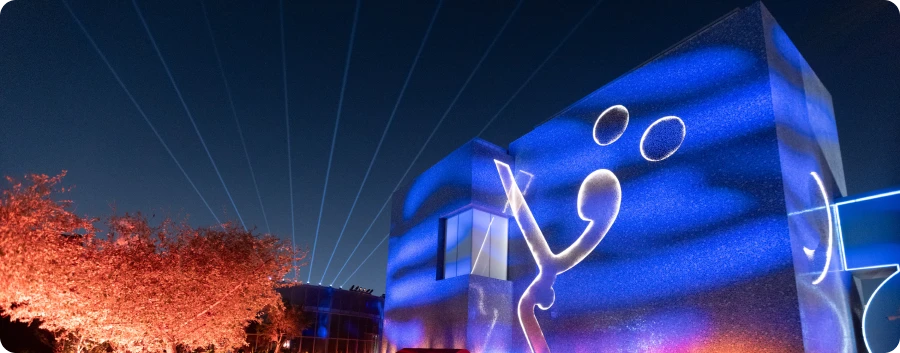
Maqbool Fida Husain Museum, Qatar — fischerAppelt
22
countries reached
~1B
estimated total reach
36M
online views
For the opening of the Maqbool Fida Husain Museum in Qatar, fischerAppelt recreated the voice of the celebrated artist — who passed away 10 years prior — using AI. That voice became the narrative anchor of the evening, guiding 250 guests through the museum inauguration as if Husain himself were present. The event reached 22 countries, generated approximately 1 billion in estimated total reach, and 36 million online views — for an audience of 250 guests on the night.
What made it work:
Deep cultural research preceding any AI application
A clear narrative role defined before the technology was chosen
Full transparency — the AI voice was acknowledged
Human authorship at every creative decision point
2. Production: AI expanding the volume and variation of creative event assets
A second role for AI is less visible but equally significant: generating the volume and variation of assets that traditional production simply cannot match at speed or scale.
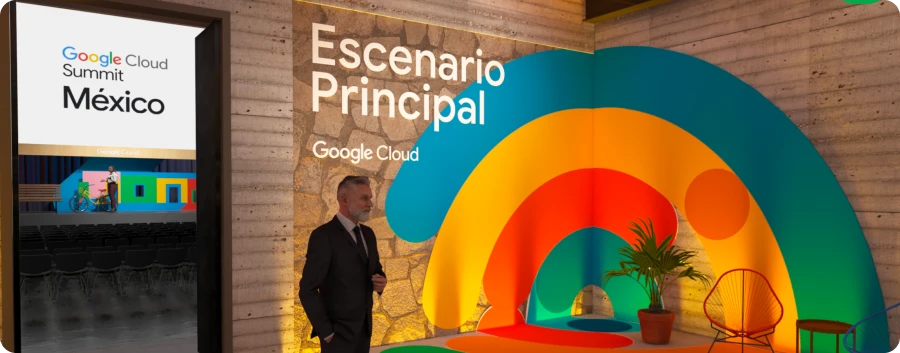
Google Cloud Summit Mexico 2025 — RED DOOR AGENCY
2×
previous attendance figures
+123%
beat registration goals
227%
ROI vs previous campaigns
For Google Cloud Summit Mexico 2025, RED DOOR AGENCY set a bold creative constraint from the start — zero image banks. Every texture, wall design, and floor pattern across the summit’s “El Pueblo Mágico” village was generated using Google’s AI models. Humans provided the cultural context — Mexican folklore, architecture, and color — while AI handled the visual execution. The summit doubled previous attendance figures and beat registration goals by 123%. 227% ROI compared to previous campaigns. Zero percent technical downtime across more than 12 hours of live AI activations.
What made it work:
A strict creative constraint that forced AI into a specific role
Human cultural expertise informing every AI-generated output
AI used to deepen specificity, not replace it with generic assets
Clear creative ownership maintained throughout
This approach connects directly to a broader principle in award-winning event design: the strongest work treats its tools — whether AI, architecture, or how to stage audience participation — as creative material with a defined role.
3. Experience: AI responding to or co-creating with participants in real time
The third role is the most interactive — and the fastest-moving area of development in this year's entries.
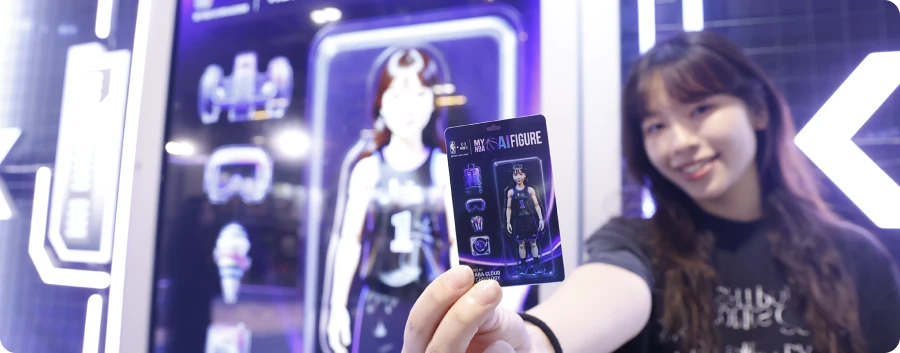
Alibaba Cloud × NBA activation, Macao — George P. Johnson
53,848
visitors over five days
1,185,500
digital interactions
At the Alibaba Cloud × NBA activation in Macao, George P. Johnson built an AI-powered system that turned every fan moment into broadcast-quality content in real time. AI Bullet-Time replays, an AI Avatar generator, an AI voice host, and robotic basketball gameplay ran as one connected loop — with the cloud orchestrating each interaction live. The activation drew 53,848 visitors over five days and generated 1,185,500 digital interactions.
What made it work:
AI given a specific interactive brief rather than open-ended creative freedom
Human moderation and creative direction maintained throughout
Audience engagement designed around the AI interaction, not added to it
Outcomes defined and measured before the event
What separates creative AI use from decorative AI use across 1405 entries
All case studies this year share the same common threads:
Defining the role precedes selecting the tool. The teams that used AI most effectively didn't start with "let's use AI." They started with a creative problem — narrating a legacy, building at cultural scale, personalizing at volume — and identified AI as the right tool for that specific job.
Human expertise shapes every output. Mexican folklore. A deceased artist's voice and gesture. The emotional arc of a farewell. In each case, the cultural and narrative intelligence was human. AI executed and expanded it.
Transparency is built in. The strongest AI work in 2026 didn't hide the technology. It named it, framed it, and let audiences experience it openly. That transparency is also an ethical obligation — particularly when working with voices, likenesses, or cultural material.
Permissions and authorship are established early. Working with AI-generated likenesses, voices, or culturally specific material requires clear rights frameworks before production begins. This is not a legal footnote — it's a creative and reputational decision.
What this means for your next brief
AI works best when it has a job to do — a specific cultural context, a narrative role, a creative constraint that forces it toward specificity rather than generality. Before reaching for it, ask:
What is the one thing AI can do here that the team cannot do at this scale, speed, or fidelity?
Who owns the cultural and narrative intelligence that will inform the AI output?
How will the AI's role be communicated — and does that communication serve the experience?
What permissions, rights, and authorship frameworks need to be in place before production begins?
How will you measure what the AI contribution produced, specifically?
Explore more insights from the Eventex Excellence Report 2026
AI as a creative partner is one of six dimensions separating award-winning events from the rest. The Eventex Excellence Report 2026 explores the patterns, data, and case studies behind the world’s most outstanding events and experiences.
What does AI as a creative partner mean in events?
It means giving AI a defined creative role — as a narrator, a visual production engine, or a real-time interaction system — rather than using it as a background automation tool. The strongest AI-driven work in Eventex Awards 2026 was transparent, culturally grounded, and human-directed at every creative decision point.
How are event agencies using AI creatively in 2026?
The Eventex Awards 2026 data points to three distinct approaches: AI as a narrative voice or character (fischerAppelt’s Maqbool Fida Husain Museum opening); AI generating culturally specific creative assets at scale (RED DOOR AGENCY’s Google Cloud Summit Mexico); and AI responding to or co-creating with participants in real time (George P. Johnson’s Alibaba Cloud × NBA activation). Each required deep human creative direction to work.
Does using AI in events improve award performance?
The data shows a strong correlation: Platinum-winning events were five times more likely to feature AI as a creative collaborator than non-winning entries. That is a correlation, not a cause — adding AI does not guarantee recognition. What the data shows is that teams using AI with a clear creative brief, cultural context, and defined role consistently produce stronger work.
What are the risks of using AI in event production?
The main risks are generic output, cultural insensitivity, and unclear authorship. AI without a specific human brief tends to produce assets that feel unspecific and interchangeable. Working with voices, likenesses, or culturally significant material requires clear rights frameworks and transparency with audiences. The strongest AI work in 2026 addressed all of these before production began.
How do you maintain human authorship when using AI in events?
By treating AI as a production tool that executes human creative decisions, not as a replacement for them. In every strong example from the 2026 data, the cultural intelligence, narrative direction, and creative constraints were human. AI expanded the volume, variation, or fidelity of the output — it didn’t generate the idea.
What is the difference between AI as a production tool and AI as a creative partner in events?
A production tool automates or accelerates tasks that would otherwise be done manually — scheduling, asset resizing, captioning. A creative partner has a role in how the idea itself is expressed: narrating a story, generating a culturally specific visual environment, or responding to participant behavior in real time. The distinction matters because it changes how AI is briefed, how its output is reviewed, and how its role is communicated to the audience.
How will AI change event management?
The 2026 entry data shows the change arriving in creative work rather than back-office automation: AI narrating a museum opening, generating an entire summit’s visual environment, and running live fan interactions. What it does not show is AI replacing creative judgment. In every strong example, the cultural and narrative intelligence was human, and AI expanded the volume, variation, or fidelity of the output.
Never miss an insight worth reading.
By providing your contact information, you agree to our Privacy policy, and you authorize Eventex Awards to contact you with more relevant information about the awards. You can unsubscribe at any time via the “Unsubscribe” button at the end of each email.
Información sobre la industria de eventos que realmente merece la pena leer, en el momento justo
Recibe información del sector, acceso anticipado a informes y contenido valioso directamente en tu bandeja de entrada.
Escrito por:
Tsveta van Son
Especialista en redacción publicitaria
Como redactora, editora y traductora experimentada, Tsveta escribe para Eventex, donde cubre desde tendencias de marketing experiencial hasta las historias detrás de las campañas más premiadas del sector de los eventos. Con formación en periodismo y debilidad por la gramática islandesa, cree que el mejor contenido es preciso, útil y nunca aburrido.
Índice
Participa en los Eventex Awards
Consigue que tu trabajo sea reconocido a escala mundial
Impulsa la visibilidad, las ventas y los ingresos de tu marca
.svg)
.svg)






.webp)